Caught in the vortex. On a downward spiral.
Go oblivious with the flow. The euphoric dance to something.
Better?
Be a stone of reason, take a stand. Heels down in the ground.
Have we not been down this path before.
Panem et circenses, ha de Gött!


Caught in the vortex. On a downward spiral.
Go oblivious with the flow. The euphoric dance to something.
Better?
Be a stone of reason, take a stand. Heels down in the ground.
Have we not been down this path before.
Panem et circenses, ha de Gött!


Stora Bommens bro in Göteborg, Sweden. In English The Large Gate Bridge. The bridge is used as bike and walk bridge over the Harbour Channel but was built as a train bridge. The name comes from the toll gate that was here in the past. The gate protected the channel from invading enemies but also ensured that the mooring fees and toll could be collected.
It was replaced with a replica, where the steel parts has been kept, in 2015 and cannot be opened. The old bridge was a swing bridge, swinging open around its centre leaving two lanes for boats to pass. The old bridge was very low and slowly sinking, making it more and more difficult to pass under during high tide. It was therefore called the cheese slicer bridge by the sightseeing tour boats. The possibility to open was disabled during a renovation in 1929. I haven’t been able to find out why, but a guy-guess is that the harbour was moved out to the river bank as the boats became bigger.
The white building in the background is the the court of appeal for West Sweden.
Hold your head down, ha de Gött!


For many Swedes this quay with the white building behind was the last steps on Swedish soil as they emigrated to America. The building is named Amerikaskjulet, the Amerika Shed. It was built in 1910 to 1911 as a warehouse for the Port of Göteborg. The docking place with number 36 was the first quay with enough depth for the Svenska Amerika Liniens steamboats. As the name suggest the shipping company established in 1915 was dedicated to traffic between Göteborg and New York, USA. The company was closed in 1975 after a, in many cases, dramatic history.
To name this quite large building a shed, must be a proof of the very special humour in Göteborg. It was the first building in the area built of granite stone and concrete. Quite different to the other wooden sheds along the quay. Behind it one of Göteborg’s most famous landmarks, the Seafarers Tower with the statue of a sailors wife looking out to the west praying for husband and sons safe return from the sea. A reminder of the importance of the city as a port that it still holds today as the largest in Sweden.
Sail safe, ha de Gött!


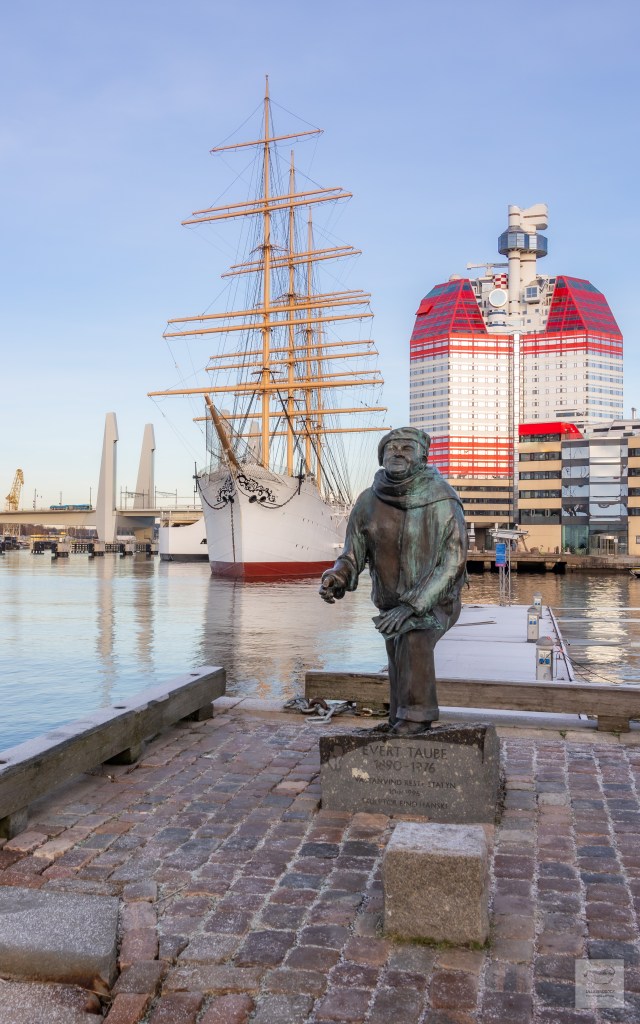
Statue of the Swedish national poet Evert Taube with the ship Viking and the building called the Lipstick in the background. I let your own imagination figure out why it is called that. This 86 meter building stand in the clay on piles that had to be driven over 90 meters down.
You cannot call yourself Swedish if you can’t sing at least one of Evert Taube’s song. He wanted to be seen as a poet and writer but is know by most as singer-songwriter. He was born 1890 in Göteborg and he grew up at Vinga lighthouse outside the port of Göteborg. As a young man he sailed the seven seas and spent time in Argentina. A theme he often returned to in his writing. Many of his works has been translated into English. There are some links available on Wikipedia.
While the boat still sails on, ha de Gött!


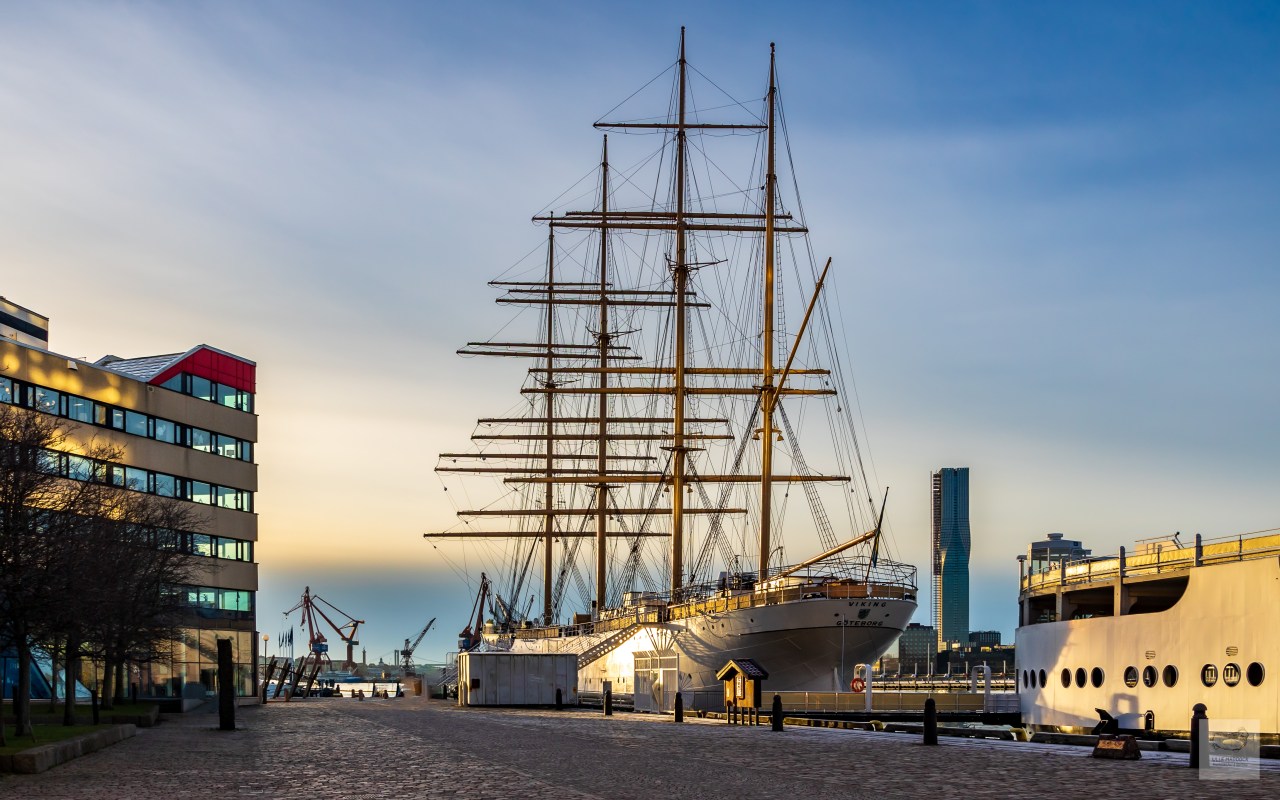
This old sail ship has been a symbol and landmark in Göteborg since 1951. It has been moored basically in the same place since then. It was originally built 1906 in Copenhagen, Denmark as school ship for the Danish merchant fleet. It is the largest sail ship ever built in Scandinavia. She served in Denmark until 1928 and after that the four-masted beauty was sold to Åland. There she served as merchant and passenger ship before finally arriving to Göteborg in 1951. This time to once again serve as a school but without ever to set sail again. Today it is a hotel and restaurant.
Sail, sail away on the winds of hope. Ha de Gött!


The new bridge over Göta Älv in Göteborg, Sweden is one of the things I’ve wanted to photograph for a long time but never got around to do. But yesterday all the pieces fell together. The light was good and to top it all, they opened the bridge to let a ship loaded with timber to pass. One of those hallelujah moments for a photographer.
The new Hisingsbron was inaugurated in 2021 to replace the old Götaälvbron from 1939 that was in poor condition. Götaälvbron in turn replaced the original Hisingsbron from 1874 that was in operation until 1968. The new bridge is lower to make it easier to ride your bike across. The downfall is that the sail free hight is lower and the ships passing underneath must run on a schedule to avoid openings during the rush hours.
Be like a bridge, open to all connections. Ha de Gött!


Narrow gate in the Skansen Kronan fortification in Göteborg. The half inscription should read Carl XII stig, Carl XII path.
Don’t be narrow minded, keep your mind wide open. Ha de Gött!


The Crown redoubt was built between 1687 and 1700 as part of Göteborg’s defence system. It is built on a steep mountain Risåsberget above Haga city district. Takes your breath away in more ways than one. The stone building is 33 meters high and reaches 87 meters above the sea level. The sconce has a twin Skansen Lejonet (Lion redoubt). Today the fortification has a better use for conferences and parties.
Take a deep breath, ha de Gött!

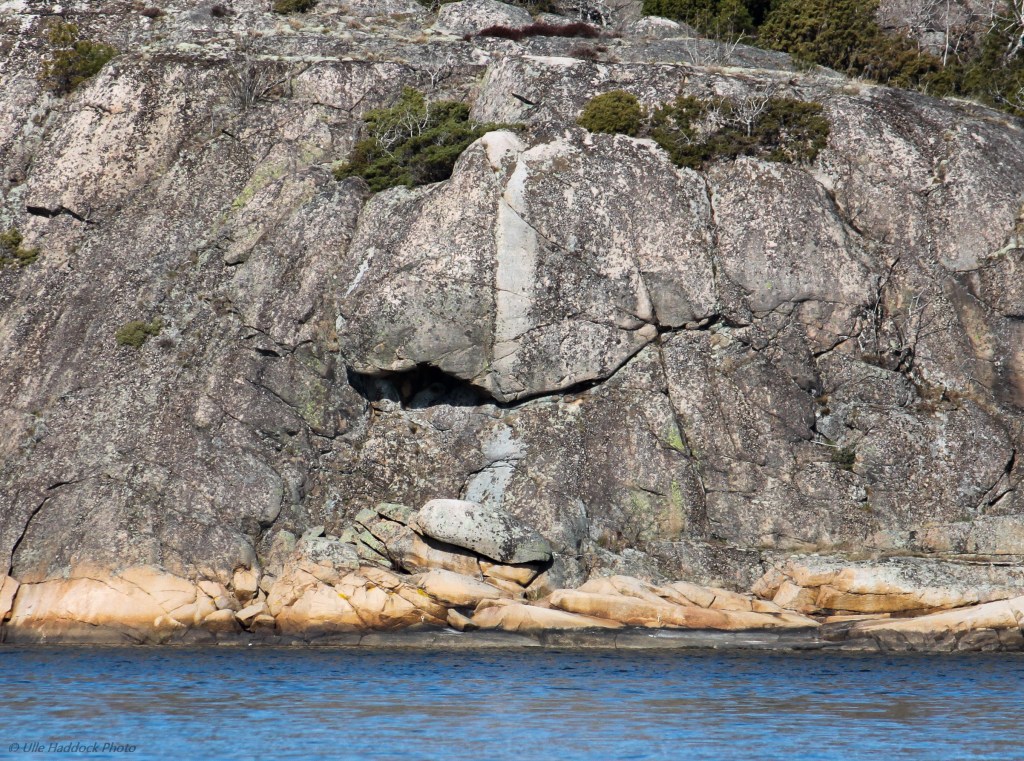
I found this giant’s kettle at Lindö. It’s approximately one meter in diameter and I estimate it to be around one meter deep. In the folklore these holes was created, and was used for cooking by the giants that in the past roamed the world. Hence the name. The giants tossed large boulders at each other when fighting. You can find these laying randomly in nature. God was angry with them and turned them into stone. Yes, if you look close, you can see them in the hills.

There is of course a more scientific explanation, equally forceful. As the inland ice shelf melted away huge rivers with strong currents was formed. When a smaller rock was trapped and started to spin it grinded down into the solid rock. These stones can sometimes be found at the bottom with a perfectly smooth egg shaped surface.
Don’t throw stone in a glasshouse, ha de Gött!


A bit of adventure this weekend to Trossö-Kalvö-Lindö. These three islands are today really one island as a result of the land elevation. Land elevation has been going on since the last ice age and still continues by 1 mm per year. There are no cars on the island but there’s a 5 km road that was built around 1930. The plans was to build a bridge over the 150 meter Havstensund strait, but with the rapid decline in population the plans was sent to the scrap bin. In 1930 there was 80 inhabitants but in 2005 only 10.

Today almost all of the island is a nature preserve. Tthe thin soil layers with sand and lime makes the flora rich. The fields are kept open by the freely grazing highland cattle on the island. The islands can only be reached by private boat but they are well worth a visit. I will share some more pictures in the coming weeks.
Among cows, watch your step. Ha de Gött!