Tag Archive for ‘Travel’

Published

Published

Yes, it’s true I’ve got an article published in a local newspaper called Veckovis. It’s very local so I share it here with you. Written in Swedish originally so I hope not too much is lost in translation.

The Turquoise Bridge
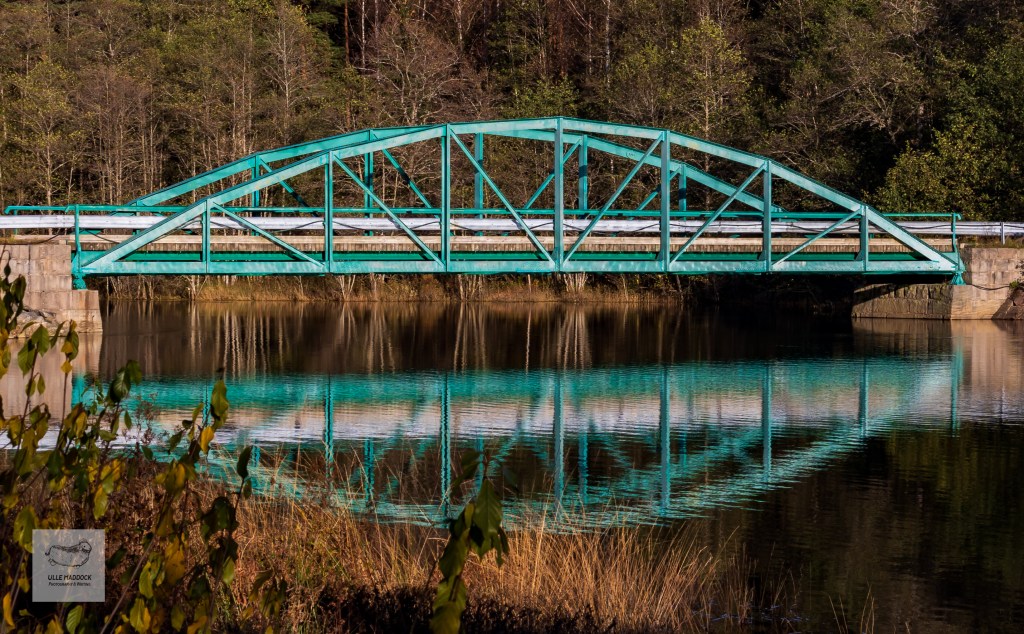
At the top of Norra Bullaren where the lake turns into Enningdalsälven we find this beautiful turquoise pearl. This beautiful bridge is probably missed by most people who pass by on the Blue-Green road towards the Norwegian border. Nowadays, both the store and the petrol station are closed on the Swedish side. But if you stopp from nostalgic reasons, like me, and look down to the lake, you see it. As an avid hobby photographer, you are drawn to such beauty as bees to nectar-filled flowers. 

The narrow cast iron bridge with wooden carriageway were built almost 100 years ago. The proud logo from Götaverken, Gothenburg, is embedded in the turquoise together with the year 1926. A work like this must have songs and poetry dedicated to it, I thought. Happily, I threw myself over a famous search engine on returning home. All searches on bridge Vassbotten came up quite empty. Searches on Enningdalsälven resulted in more hits on Älgafallet.

Even though Älgafallet is mighty and makes the photographer’s motive sensors go off at full speed, it was a bridge I wanted to know more about. Here it was important to make a “Message Board” with the thoughts and try something new. Götaverken. For me, who was born in Gothenburg, it is above all a shipyard. My father, who by the way was from Holkekärr in Bullaren, worked there when I was a child. Yes that is correct. I’m half-bulling in the embezzlement, hence the nostalgic stop at the store. The bridge, Bullaren, Götaverken and Gothenburg felt a bit like closing a circle. 

Götaverken ceased all operations in 2015, but all documentation has been saved at the National Archives in Gothenburg. Using the well-known search engine, I came to the conclusion that there was an archive of bridges and viaducts. It was in cover number nine for the years 1905 – 1937. Tab 33 Wassbotten, highway bridge Bullarens Härad 1926. A small notice “reading room” meant that it was as far as I could get in the digital world.  

Like the Phantom, would I have to leave the deep forests and wide expanses to walk the streets of the city like an ordinary man? With a son studying to be a history teacher at the University of Gothenburg, I did not have to go into the big city. This did not go down well with the wife who missed out on a shopping trip, but it is important to prioritize. After brushing off the archive dust, the good son was able to share lots of information with me.

The contract, with order number 5836, states that the bridge must have a parallel span with a length of 30 meters and a free bridge width of 4 meters. “Materials holding the requirements for cast iron class B shall be used for the iron superstructure except rivets and bolts”. “The bridge parts are to be coated twice with lead paint”. The work was to be completed on 1 October 1926 and anchorages were to be prepared by the client no later than 15 August. The contract was signed 31 March 1926. According to the contract, the price was SEK 14,500 (€1450). According to Statistics Sweden’s Price Converter, this would correspond to SEK 430,000 today (€43,000)

Test loading of the bridge took place on 6 and 7 December 1926, by loading the bridge with a 35 cm thick layer of gravel. According to the calculations in the protocol, the load was then about 600 kg / m2. The bridge arched 17 mm on the southern beam and 21 mm on the northern beam. After the load was removed, the bridge returned to its original position. In the test print protocol, I discovered that the modern spelling of Vassbotten was used with a simple V and not W as in the contract. 
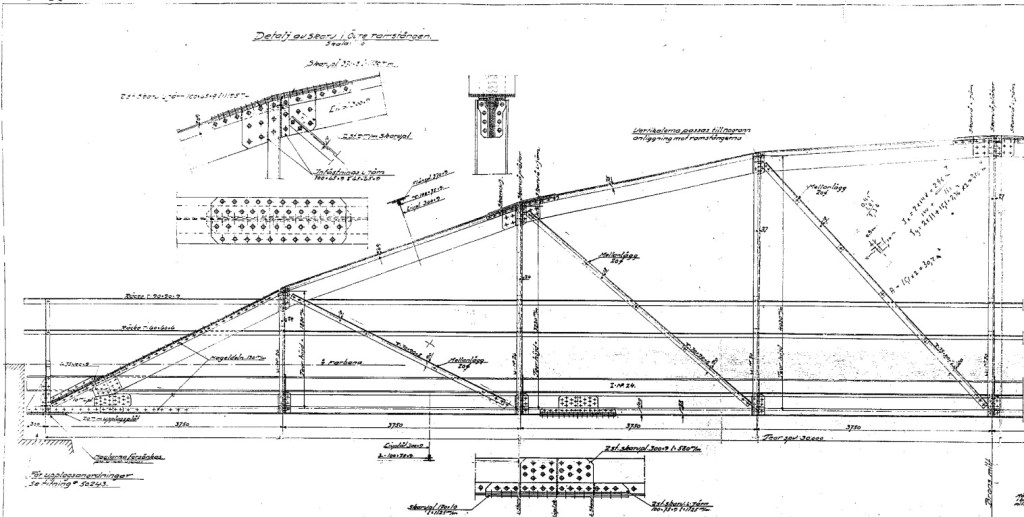
The search for more information continued through contact with the Swedish Transport Administration. A very helpful archivist produced the drawing. The drawing which was completed a week later on April 6, 1926. Drawing and subtitling are done by hand. The engineer has based his construction on the Royal Swedish Road and Water Agency’s standard drawings for road and railway bridges A17 and A20. I do not dare to interpret the engineer’s signature so his name will remain unknown. I wonder if he understood that the bridge would still be in use after almost 100 years. Here you can also read that the carriageway is made of wood. Load-bearing plank 4×4 inches and wear surface plank in the dimension 2×5 inches. 

I also received information from the Swedish Transport Administration that a renovation and reinforcement had been done in 1956. Wooden planks and steel parts were replaced. The drawing shows that “all wood except the wear plank is impregnated with arsenic and creosote preparations”. “New steel parts are coated with lead paint and coated twice with anti-corrosion paint”. Here too, we can see changes through the history of the bridge. The dimensions of the wooden plank are here stated in millimeters, 50×125.  

Lots of technology here so we return to the bridge’s beautiful appearance. Such engineering needs attention and I hope I got someone to look a little extra next time they pass. Maybe someone has been inspired to write a song about it.

Be a bridge over someones troubled waters, ha de Gött!

Advertisements

Rush hour

Rush hour

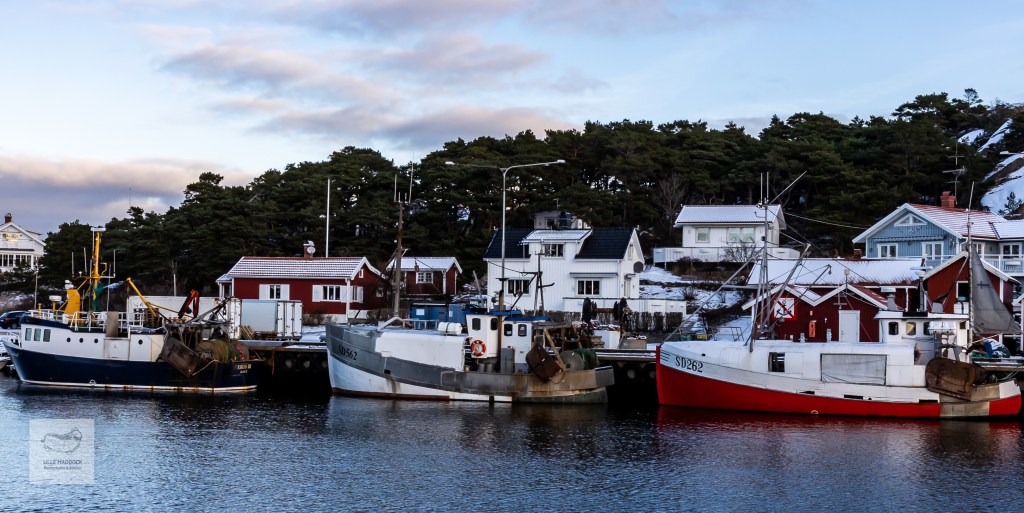
Rush hour in Havstenssund. The autumn evening shadow gently cover the houses, as the sun sets behind the cliffs. The little village prepare for the winter. Lobster fishermen moor their boats in the harbor. There is a chilly wind but in the street it is calm, sheltered by the houses and the white fences. Take a left to the gorge or go straight down to the harbor. Smell the fresh salted wind and listen to the boats tough by. Feel alive.

Breath in breath out, ha de Gött!

Advertisements

Closed

Closed

Abandoned. Slowly nature is taking back the old store. I remember coming here as a child to buy Norwegian chocolate or licorice pipes. The store is just a few meters from the border. Now it’s for many years closed and the building is for sale. Even the for sale sign has faded. You can still see the sign for Borg beer and trash can lid stating ‘Keep Sweden Clean’. Maybe this is the picture of the circular economy.

Progress is a double edge sword, ha de Gött!

Advertisements

Candelabrum

Candelabrum

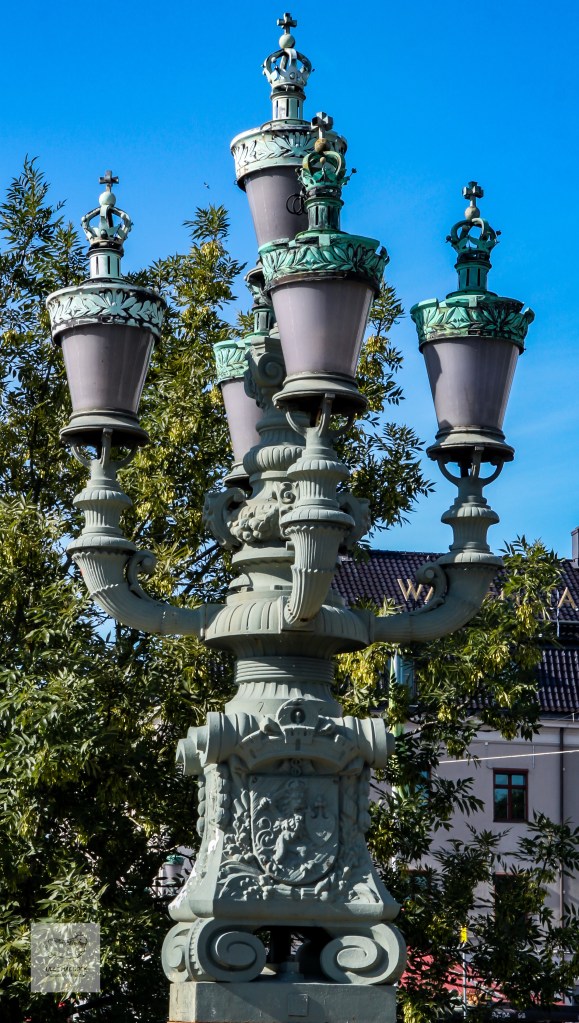
This huge candelabrum is one of several on the Kings Gate Bridge or ‘Kungsportsbron’ in Göteborg. It’s a bridge over the moat surrounding the old town. On this place in the fortified city was the Kings Gate before the walls was dismantled in the beginning of 1800. The candelabrum was iron cast for the current bridge in 1901 by Göteborgs Mekaniska Verkstad that later became Götaverken. The same company I accidentally accused for criminal activities in a previous blog (find it here). Originally lit by gas, but probably not from royal flatulence.

Let the light shine on you, ha de Gött!

Advertisements

City Speed

City Speed

The city is full of noise and everything moves in fast speed. This picture is taken in one of the busiest places in Göteborg. Tram number 11 from Saltholmen to Bergsjön passes by in speed. Not everything changes fast. The tram type was used when I was a child in the 1970:ties. In the background is the City Hall and the statue of the city founder king Gustav II Adolf.

Try not to rush through life, ha de Gött!

Advertisements

Gorge

Gorge

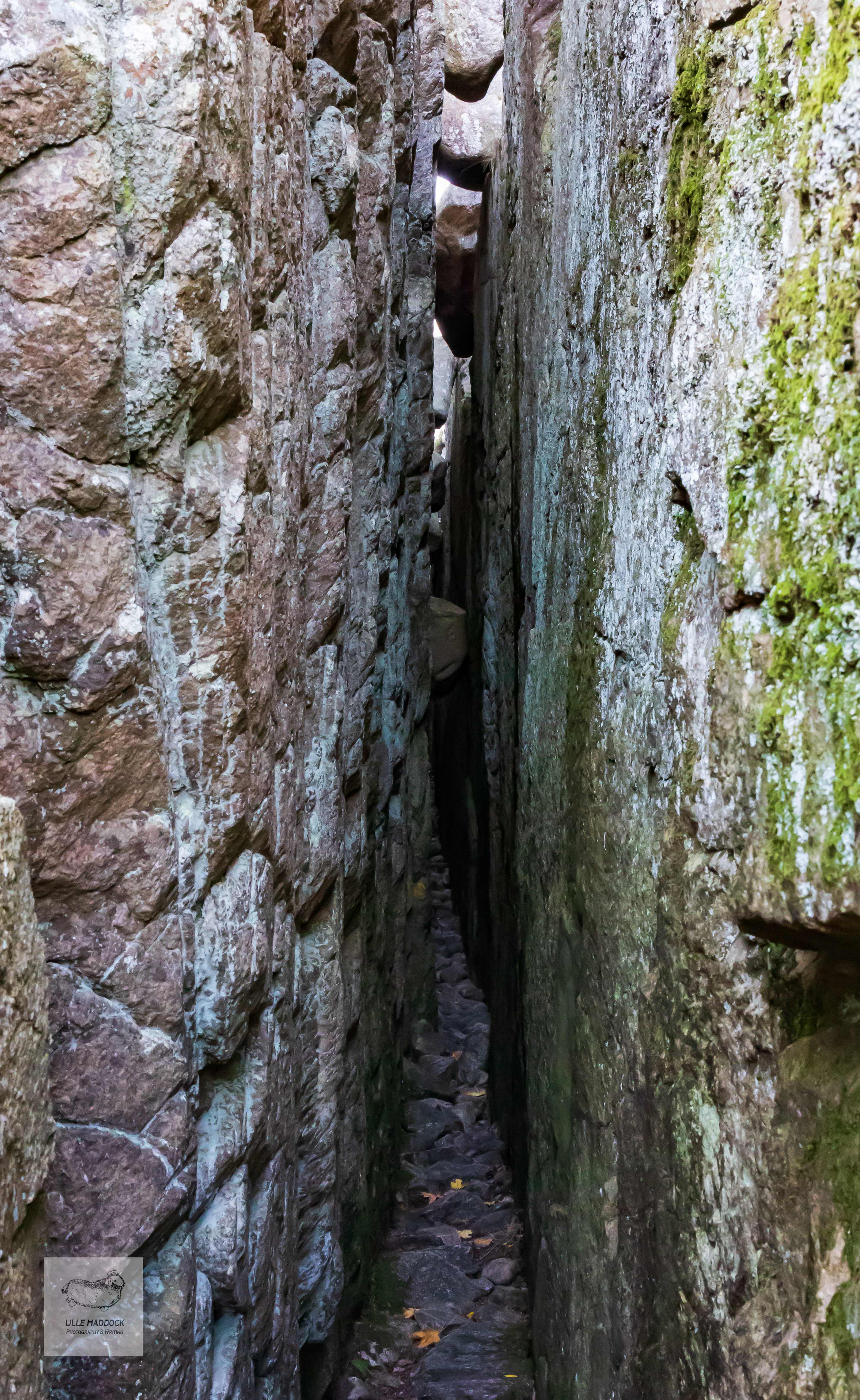
The Gorge in Havstensund is 100 meters long, 10 meters deep and less than one meter wide. By the locals it’s called “Koppraklöva”. “Klöva” is dialect word meaning gap or gorge. “Koppra” comes from the store that was in front of the entrance. The membership owned store, “Kooperativa Förbundet”, closed many years ago but the name stays on.

It’s possible to walk through if you you’re not pregnant or had to many beers in your belly. You need to be equipped with strong nerves squeezing through while wishing that the rocks hanging over your head will stay there. It is like a shadow hanging over me.

Drop a comment if you got the famous song reference, ha de Gött!

Advertisements

The Spell

The Spell

Which witch thought the toughest thought. With her wand cast a spell over the writer so he could no longer spell. Did he steal the steel! Some words are just to alike. Sounds alike but spells differently. A challenge for school kids and foreigners.

Yesterday I accidentally accused Götaverken for criminal activities. Of coarse they did not steal constructions, the made STEEL constructions. Ships, bridges and lock gates. They went out of business 2015 but I hope no former employee was offended. My father was actually one of them in the 1970:ties.

Sometimes I wonder if there is an academy of sorcerers and witches sitting there in a dark chamber deciding spelling and spells. Can you hear the laughter when they decide how to spell wit and with. How they choke for air and slapping themselves on their knees when someone throws in whit also. What a marvelous stew in the kettle of books!

Of and away with, wit, whit my broom, he he he he, ha de Gött!

Advertisements

Bridge

Bridge

The turquoise bridge reflecting in the calm water of Enningdalsälven, the Enningdal river. Just a kilometre downstream is the waterfall from my post earlier this week, find it here. The medium size river flows to the north, one of the few in Scandinavia. The nature is fantastic, I’ll be back, to quote Arnold.

The 95 year old bridge was built in Göteborg 1926 by Götaverken. Götaverken is most known for ship construction in the Harbor of Göteborg, but also constructed heavy steal constructions around the world. The steal construction is painted in a green turquoise color and held together with rivets. It’s a narrow bridge where the carriageway is made from wooden planks.

Try to stay on the straight and narrow, ha de Gött!

Advertisements

Waterfall

Waterfall

The power of nature becomes evident in a waterfall. The roaring mixes with rippling sound as the water goes over the edge. You can smell the moisture that fills the air all around, feel it in your face. The fascinating swirling of water drops as they are tossed up and falling back on the way down.

I took these pictures on my Sunday trip to Älgafallet, or Elgåfossen that is its Norwegian name. Translates to “Fall of the Moose”. The border between Norway and Sweden is in the middle of the river and the 46 meter drop waterfall. So, yes I was abroad for the first time since Covid. I’ve been working with different shutter speeds to try and capture the force of the water.

Remember we spend our first nine months in water, be careful with it. Ha de Gött!

Advertisements

Lobster

Lobster

At exactly seven o’clock the first Monday in September after the 20:th, a splashing sound symphony starts. In the first light of dawn the small boats circling each other to get the best positioning. Cheerful morning greetings are passed by those with the best spots. Grunting replies by those that just drifted a bit too far out of course. With a splash the cage goes in the water. The skill is to gently drag the cage in position on an underwater rock shelf, preferably in front of the lobster nest.

The yearly Lobster fishing season has started. This delicacy from the underwater rocks is on the most wanted list for many recreational fishermen. Yepp, that’s true mostly men. In the past the lobster has been over fished and to keep the population at a viable level there are some restrictions to follow. The shield needs to be at minimum nine centimeters and if a female specimen carries spawn it goes back in the sea. A maximum of six cages per person, that needs to be present in the boat.

The first lobster sold at the fish auction in Göteborg this morning costed 77 000 Swedish Krona, in euros €7 500.

Ha de Gött, we will, got two so far!

Advertisements